
Below is a list of the laws and principles that LawsOrEvolution.com and IsEvolutionATheory.com uses to audit and test the theory of evolution. The conclusion this site reaches is that the theory of evolution that materialist propose is incompatible with many established laws of nature. A theory that conflicts with established law cannot stand, and like many failed theories before it, it must fall by the wayside.
A note on terminology: these are variously called laws of science, universal laws, laws of nature, and laws of physics. Whatever the label, the point is the same. As Space.com puts it, “The laws of physics are universal and don’t change with time or location in space.”
Most of what I cover here are the laws of nature I have worked with throughout my career as a design engineer and project manager. They are the same everyday laws your life depends on. I want to share what I have learned since graduating from Louisiana Tech University in 1975 with a BS in Civil Engineering.
To see how these laws apply to the theory of evolution, first read this websites tab “EVOLUTION” for the big picture: a summary of evolution, its claims, and the questions you should be asking.
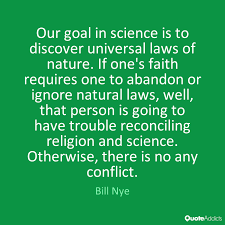
Bill Nye, the Science Guy says it well in the quote to the left. And I totally agree. Who could argue this quote?
Philosophy and Logic
- 501. The Law of Cause and Effect (Law of Causality) – for every effect there must be an antecedent cause.
- 502. Law of Non-Contradiction – (A and not A) A contradictory statements cannot both be true in the same sense at the same time,
- 503. Law of Excluded Middle – (A or not-A): For any proposition, either it or its negation is true. There is no middle ground.
- 504. Law of Identity – (A is A) An entity without an identity cannot exist because it would be nothing. To exist is to exist as something, and that means to exist with a particular identity.
- 505. Law of Uniformity – The future will continue to resemble the past. The laws of nature will continue to govern the universe as they have in the past.
- 506. Law of Sufficient Reason – Everything that exists or happens has a reason, cause, or ground proportional to its consequent.
Science
601. First Law of Thermodynamics – Thermodynamic statement: The change in a system’s internal energy equals the heat added to the system minus the work done by the system (ΔU = Q − W).
602C. Second Law of Thermodynamics (Clausius – 1854) – Heat cannot spontaneously flow from a colder body to a hotter body..
602K. Second Law of Thermodynamics (Kalvin – 1851) – No cyclic process can convert heat entirely into work. A corollary is that the entropy of an isolated system never decreases.
603. Conservation of Energy – General statement: Energy cannot be created or destroyed but only converted from one form to another.
604. Conservation of Matter – Matter cannot be created or destroyed but only converted.
605. Law of Information – A principle proposed by Werner Gitt. Information cannot be created by matter alone. (Click Here to read the Law’s Corollary Principles).
606. Law of Biogenesis – Life comes only from pre-existing life, as established by the experiments of Redi, Spallanzani, and Pasteur. Gregor Mendel’s develops this law further in his laws of inheritance explaining how physical traits are passed to offspring.
607. Newton’s First Law – Inertia: An object remains at rest or in uniform motion unless acted on by an external force.
608. Newton’s Second Law – Momentum or F=ma: An object’s acceleration is proportional to the net force acting on it and inversely proportional to its mass. In other words, the velocity of an object changes when it is subjected to an external force.
609. Newton’s Third Law – Equal and Opposite or Action/Reaction: For every action (force) there is an equal and opposite reaction.
610. Law of Universal Gravity – Newton’s law of universal gravitation: Every particle in the universe attracts every other particle with conditions based on the mass of the objects and the distance between them. Specifically, with a force proportional to the product of their masses and inversely proportional to the square of the distance between them.