I want to compare the law of information with Archaeopteryx that evolutionist claim as the fossil evidence linking dinosaurs to birds. Please allow me to call him or her Archie in this article. For readers not familiar with the definition of information consider this one: “Information is that which produces a specific effect.” In this post, I am referring to DNA information that produces the specific effect of a creature.

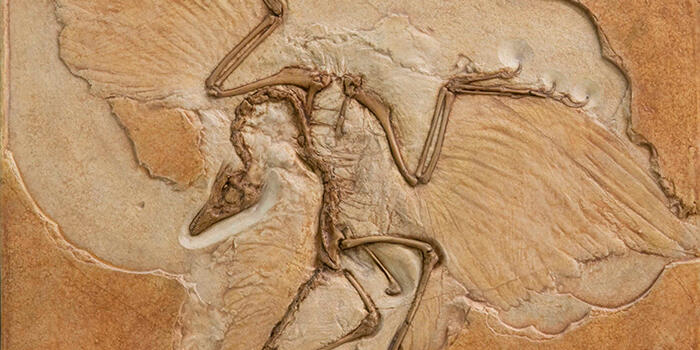
Here is Archie on the left. I invite you to look at 3 Archie sources that I site below.
Live Science website: Click here.
This is a summary: Paleontologists view Archaeopteryx as a transitional fossil between dinosaurs and modern birds.
American Museum of Natural History : Click here.
This is a summary: Archie represents a turning point in paleontologists’ understanding of dinosaurs transitioning into birds.
Understanding Evolution from Berkeley University: Click here.
This is a summary: As birds evolved from two-legged dinosaurs called theropods over millions of years their features were modified through a complex series of steps.
Here is the Theropod which, according to Berkley University’s article, is Archie’s grandmother.
Now that you see Archie’s fossil and an example of a Threropod, let us dig deeper.
Let us examine some Key Evolutionary Changes: Think about the reality of this: To make the physical changes from a ground-dwelling dinosaur to a flying bird, I have listed the following major features that had to change. Ask yourself what mechanism can make these and more changes not listed like hormones?
Go thru quickly and provide more detailed description in a PDF below.
- Feathers: Scales gradually modified into complex feathers. These first provided insulation to trap body heat, and later helped with gliding, display, and flight.
- Skeletal shrinking: Bodies became much smaller and lighter over time. Skulls also adopted a juvenile, baby-like shape even into adulthood.
- Bony tail reduction: The long, heavy dinosaur tail shrank into a tiny stump and fused into a small bone called a pygostyle to improve balance and air control.
- Wings and arms: Front limbs grew longer and stronger, shifting the primary mode of movement from running to flapping flight.
- Legs: Back legs grew less powerful, weaker and thinner. Circulation changed to allow the legs to tolerate cold conditions without frost bite.
- Wishbone and breastbone: A large, keeled breastbone developed to anchor powerful flight muscles, supported by a fused collarbone (the wishbone) to act as a spring during wing strokes.
- Respiratory system: Lungs evolved into a specialized system with hollow, pneumatic bones and air sacs that constantly cycle air to supply the massive amounts of oxygen needed for flight.
- Tooth loss: Early transitional species like Archaeopteryx had teeth, but modern bird lineages eventually lost them entirely in favor of lightweight keratin beaks.
- Digestive: Entire change in the digestive system from meat and plants to seeds, insects, fruits and nuts.
- Flight: As apex predators using strong offense with physical traits like speed, powerful jaws, strong leg sprinting and head crest, they transitioned to an avoidance creature by running up trees and ground-up flapping.
- Heart:transitioned from 3 chamber to 4 chamber with new plumbing. Science News: https://www.sciencenews.org/article/three-four-chambers “The major question has been, what drove the evolution of the four-chambered heart?” comments James Hicks, an evolutionary biologist at the University of California, Irvine.
- Temperature Control: Most reptiles are cold blooded. Birds are warm blooded. Birds have to make and control their body head. Ectothermic vs. endothermic.
- Operating System: The brain and nervous system have to reconfigure to operate its new features: heart, digestion, respiratory, legs, etc.
Given the law of conservation of information that say: Physical information in an isolated system remains constant over time. We know that the DNA information in an animal or your smart phone app information; it all stays the same; once it is loaded, it remains constant.
Think of it this way. Your smart phone is an information system. You speak information into your smart phone, the screen presents information, the app is information telling the smart phone to manipulate information.
The information in your smart phone and apps remains constant unless an outside mechanism messes with it. That is you and me changing the information system. When I download something my information system asks something like, “do you want this download to make changes to your computer?” On the evolution side My question: What mechanism changes the DNA information system in an animal?
Genetic science says that an animal’s DNA controls its features. Evolution understands the law of causality when they say that pressures like natural selection, time, random chance, mutations, migration, etc. changed all of the reptile features needed to create a bird.
Understanding the law of conservation of information and the theory of evolution, I have a question for you. Can evolution pressure change a reptile’s DNA information system to a bird’s DNA information system? What mechanism made the changes?
Side note: From a reality point of view, I don’t see how a theropods could survive in evolution’s “survival of the fittest” environment during this million-year transition.
I believe in science, and for this Laws based engineer, I think that science needs to open up a new field of inquiry. The law of information does not fit with evolution’s claims of changing DNA information. You decide.